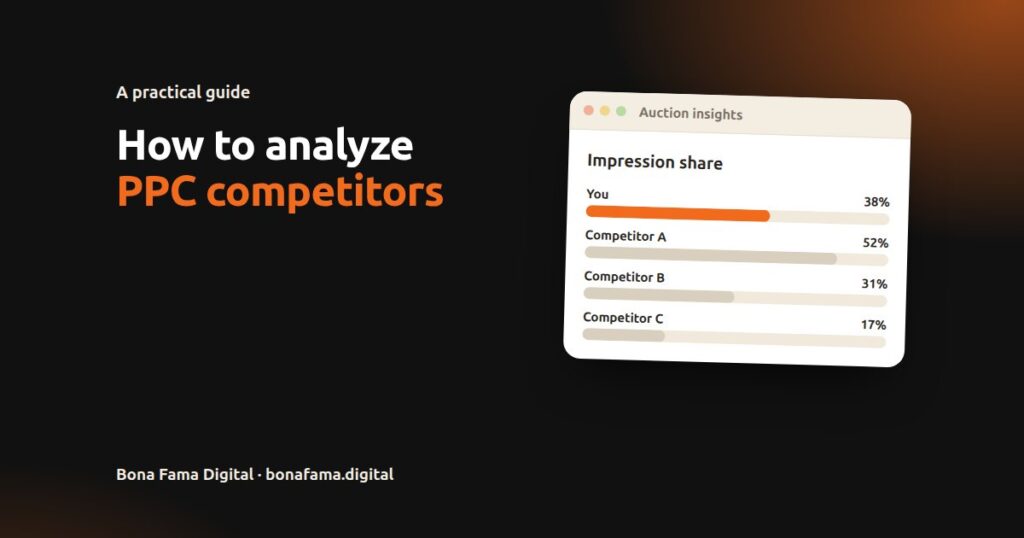
To analyze a PPC competitor, find out who you actually compete with in the ad auctions (Google Ads Auction insights), collect the ads they are running (Google Ads Transparency Center and Meta Ad Library), compare the keywords, offers and landing pages behind those ads, then turn the gaps you find into tests in your own account. Repeat the review every quarter, or sooner when costs jump.
The goal is not to copy competitors. It is to understand why a searcher might click their ad instead of yours, and to give them a better reason to choose you.
Who Are My Real PPC Competitors?
Your real PPC competitors are the advertisers who appear in the same ad auctions as you, which is not always the same list as the businesses you compete with offline. A national brand, a marketplace or a lead-generation site may be bidding on your keywords even if you never meet them in a sales pitch.
To find them:
- Open Auction insights in Google Ads (from the Campaigns, Ad groups or Keywords view) and note every domain that appears often.
- Search your top keywords using Google’s Ad Preview and Diagnosis tool, set to your target location, so you see the ads without generating fake impressions or clicks.
- List three to five competitors that appear most often, plus any newcomers.
Never click competitors’ ads to “research” them. It wastes their budget, can be treated as invalid traffic, and tells you nothing you can’t see in the tools below.
Related: Google PPC management
What Do the Auction Insights Metrics Mean?
Auction insights compares your performance with other advertisers in the same auctions. Search campaigns show six statistics:
| Metric | What it tells you | What to look for |
|---|---|---|
| Impression share | Impressions received as a share of those you were eligible for | A competitor with a much higher share is outbidding you or has better ad quality |
| Overlap rate | How often a competitor’s ad showed when yours did | High overlap means you are fighting for the same searches |
| Position above rate | How often their ad showed above yours when both appeared | A rising rate means they are bidding more or improving their ads |
| Top of page rate | How often an ad appeared above the organic results | Shows who is getting the most visible slots |
| Absolute top of page rate | How often an ad was the very first ad | The most visible, and usually most expensive, position |
| Outranking share | How often you ranked above them, or showed when they didn’t | Your overall win rate against that competitor |
Shopping campaigns show impression share, overlap rate and outranking share. Check the report by month to spot when a new competitor entered or an existing one increased pressure.
How Can I See What Ads My Competitors Are Running?
Use the free ad libraries run by the platforms themselves:
- Google Ads Transparency Center: search by advertiser or website name, then filter by region, date and format to see their search, display and video ads, and when each was last shown.
- Meta Ad Library: search by Page name to see every active ad running on Facebook, Instagram, Messenger and Audience Network. Spend and reach figures are only shown for ads about social issues, elections or politics, and in some regions.
- Microsoft Advertising: Auction insights is also available if you advertise on Bing.
Save screenshots in a simple swipe file, dated, so you can see how competitors’ messaging changes over time.
Related: Facebook ads management
How Do I Analyze Competitor Ad Copy and Offers?
Compare every competitor’s ads on the same points, side by side:
| What to compare | Questions to ask |
|---|---|
| Headline promise | What outcome or benefit do they lead with? |
| Offer | Discount, free quote, free trial, free shipping, guarantee? |
| Proof | Reviews, years in business, awards, client numbers? |
| Price signals | Do they show prices, “from” prices or none? |
| Call to action | Book, call, get a quote, shop now? |
| Assets | Sitelinks, callouts, structured snippets, images, phone number? |
Look for what everyone says (that’s the table stakes) and what no one says (that’s your opportunity). If every ad promises “fast service”, a specific guarantee or a clear price will stand out more than one more claim of speed.
How Do I Find Competitor Keywords?
Start with Google’s own tools, then add a third-party tool if you need more depth:
- Keyword Planner: enter a competitor’s website in “Start with a website” to get keyword ideas based on that site’s content, with Google’s bid ranges.
- Your search terms report: shows the real searches that triggered your ads. Compare it with the terms you see competitors appearing on.
- Third-party PPC research tools: estimate which keywords a domain bids on and roughly how much it spends. Treat these as estimates; no tool can see a competitor’s actual budget or account.
Sort the results into three lists: keywords you both target, keywords only they target (test these), and keywords you should exclude as negatives.
On brand terms, Google may restrict the use of a trademark in ad text when the owner complains, but bidding on another company’s name as a keyword is generally not restricted by Google. It can still raise legal and reputational issues, so get advice before you do it.
Related: SEO benchmarking against competitors
How Do I Compare Competitor Landing Pages?
Open each competitor’s landing page on a phone and check:
- Message match: does the page repeat the ad’s promise straight away?
- Speed: run it through PageSpeed Insights and compare the Core Web Vitals with your page.
- Friction: how many form fields, and is the phone number tappable?
- Trust: reviews, guarantees, accreditations and clear contact details.
- Offer: is the deal on the page the same one in the ad?
A competitor with weaker ads but a much better landing page may still win more customers per dollar. Landing page quality also affects your Quality Score and what you pay per click.
Related: landing pages and funnels
How Do I Turn PPC Competitor Analysis into Action?
Write down three to five changes, test them one at a time, and measure each against your current cost per conversion:
- Ad copy tests that answer what competitors don’t (a guarantee, a price, faster booking).
- New keywords from the “only they target” list, in their own ad group with a modest budget.
- Negative keywords for the searches you don’t want to pay for.
- Landing page fixes where a competitor’s page is faster or clearer.
- Bid and schedule changes for the times and locations where you are being outranked on profitable keywords.
Repeat the review quarterly, and immediately when your cost per click or cost per conversion jumps without an obvious reason; a new competitor in Auction insights is often the cause.
Related: web analytics setup · competitor SEO benchmarking
Frequently Asked Questions
How do I analyze PPC competitors?
Use Google Ads Auction insights to see who you compete with, view their ads in the Google Ads Transparency Center and Meta Ad Library, compare keywords, offers and landing pages, then test changes in your own campaigns.
Can I see how much my competitors spend on Google Ads?
No. Google does not reveal competitors’ budgets. Third-party tools can estimate spend and keywords, but treat these as rough guides rather than facts.
Is it legal to bid on a competitor’s brand name?
Google generally does not restrict competitor brand names as keywords, but it may restrict trademarks in ad text after a complaint, and laws differ by country. Get advice before targeting another company’s brand.
How often should I review PPC competitors?
Quarterly is enough for most accounts, plus an extra check whenever your costs rise sharply or a new advertiser appears in Auction insights.
What is a good overlap rate in Auction insights?
There is no ideal number. A high overlap rate simply means you and that competitor are chasing the same searches, so their ads, offers and landing pages deserve close attention.
Get a Competitive PPC Analysis Done for You
Our competitive PPC analysis reviews competitor search and social ads, keyword overlap and landing pages, estimates share of voice, and gives you clear recommendations. It can be a one-off review or refreshed quarterly.
👉 Request a free consultation.