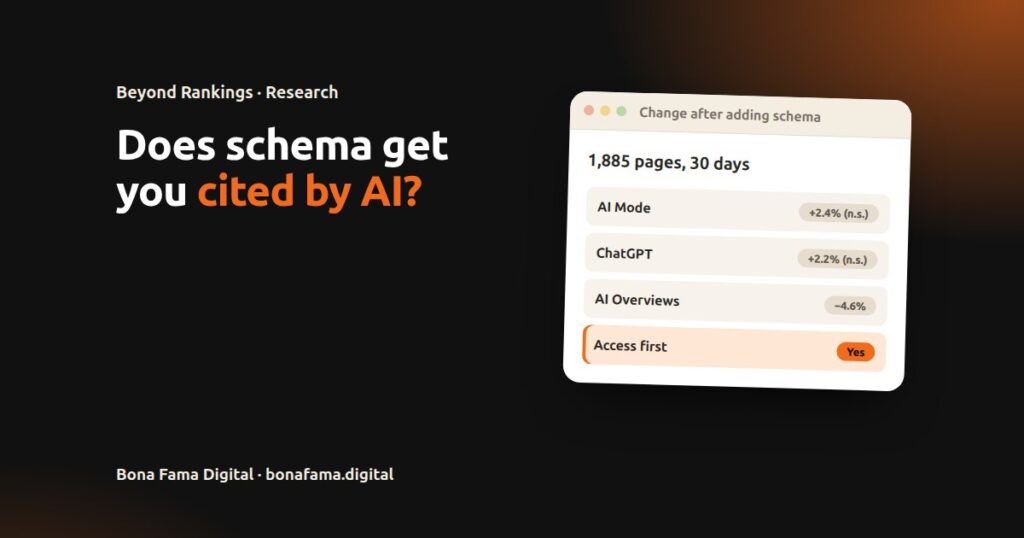
Not on current evidence, at least for pages that are already being cited. In a controlled study of 1,885 pages that added JSON-LD schema, AI citations didn’t rise in AI Mode or ChatGPT, and dipped slightly in Google AI Overviews. Technical access is a prerequisite: AI systems can’t use a page they can’t crawl, index or quote. But once that bar is cleared, the evidence that technical tactics win extra citations is weak, and the popular “up to 40%” GEO claim doesn’t hold as a general rule.
This is the fifth finding of Beyond Rankings, our review of 36 studies on search and AI visibility.
What Does Google Say You Need for AI Overviews?
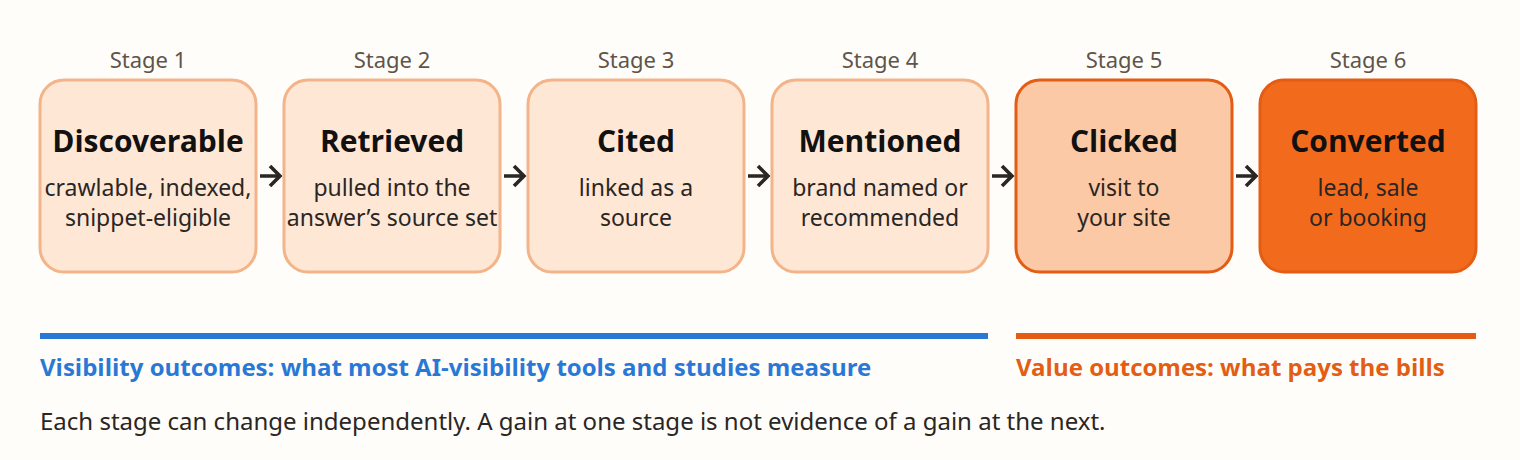
Google’s own documentation says there are no additional requirements, and no special optimizations, for appearing in AI Overviews or AI Mode. A page must be indexed and eligible to show a snippet, and the usual SEO best practices apply. You can limit what’s used with nosnippet, max-snippet and noindex.
In other words, the entry ticket is the first stage of the journey from visibility to value.
What Happened When Pages Added Schema?
Ahrefs compared 1,885 pages that added JSON-LD structured data between August 2025 and March 2026 with matched pages that had similar citation levels but never added it. Thirty days later:
| AI platform | Change in citations vs. matched pages | Meaning |
|---|---|---|
| Google AI Mode | +2.4% | Statistically indistinguishable from zero |
| ChatGPT | +2.2% | Statistically indistinguishable from zero |
| Google AI Overviews | −4.6% | A small, statistically significant decline the authors couldn’t attribute to schema |
The study has limits. Every page was already heavily cited (100 or more AI Overview citations), schema types were pooled together, and follow-up lasted 30 days. So it shows schema isn’t a lever for pages that are already visible. It doesn’t show schema is useless for new or uncited pages, or for rich results in ordinary search.
What About llms.txt and Other “AI-Ready” Signals?
They’re less common than the hype suggests, and unproven. The 2025 Web Almanac crawled more than 16 million websites. Only 2.1% had an llms.txt file, which Google says it doesn’t use, and 39.6% of those files were generated automatically by a single WordPress plugin. GPTBot was named in 4.5% of desktop robots.txt files. Data like this shows what sites do. It can’t show whether doing it helps.
Does “GEO” Content Rewriting Boost AI Visibility by 40%?
No, not as a general claim. A critical survey of 45 generative engine optimization (GEO) studies traced the widely repeated “up to 40%” figure to a single metric in a simulator where the documents were already in the model’s context. In one benchmark, only 3 of 54 method-and-domain combinations produced a significant positive effect.
Controlled experiments do find small, conditional effects. Rewriting a document in a structured format added about half a citation per answer, but the effect on whether it was cited at all was inconclusive. An observational study found pages with statistics, definitions and comparisons were used more heavily in answers than pages formatted as Q&A.
Is AI-Written Content Penalized?
Not as such. In Ahrefs’ studies, pages with less than 20% AI-detected text made up 55.9% of position-one results and 51.1% of position-ten results, and AI-heavy pages were indexed somewhat less often (40.4% against 49.3%). An earlier study of about 600,000 pages found almost no correlation (0.011) between AI share and ranking. The safest reading is the authors’ own: quality, not the tool, drives performance.
Prerequisites vs. Growth Levers
| Practice | Role |
|---|---|
| Crawlable, indexable, snippet-eligible pages | Prerequisite |
| Not blocking AI search crawlers you want to appear in | Prerequisite for that platform |
| Fast, well-structured, accurate pages | Prerequisite plus a modest lever |
| Schema on pages already cited | Not a citation lever |
| Schema on new or uncited pages | Unknown, not yet tested |
llms.txt |
Unproven |
| Clear structure, statistics and definitions | Small, conditional lever |
| GEO rewriting for a promised percentage gain | Unsupported as a general claim |
What to do: fix access first with an SEO audit, keep schema for what it’s proven to do (rich results and clarity), and be skeptical of anyone promising a percentage uplift in “AI visibility” from markup or formatting alone.
Put the Effort Into Answers, Not Markup
If markup isn’t the lever, content is: pages that genuinely answer the questions your customers ask. FamaCue finds those questions in your Search Console data and in Google, groups near-duplicates into topics, shows which ones no page on your site answers yet, and drafts a first version with an SEO checklist for every gap. Try it free for 7 days, no card needed.
Find the questions your site doesn’t answer yet
Frequently Asked Questions
Does schema markup help you get cited by ChatGPT or AI Overviews?
Not for pages already being cited. A controlled study of 1,885 pages found no significant gain in ChatGPT or AI Mode and a small decline in AI Overviews after 30 days.
Do I need llms.txt for AI search?
There’s no evidence it helps. Google says it doesn’t use it, and only 2.1% of websites had one in mid-2025.
Is the “GEO increases visibility by 40%” claim true?
Not as a general claim. It comes from a single metric in a simulator; real-world effects of content rewriting are small and inconsistent.
What technical work does AI search actually need?
Pages must be crawlable, indexable and eligible to show a snippet, and you shouldn’t block the AI search crawlers you want to appear in.
Sources
- Kimachia, K. (2026). Beyond Rankings. Bona Fama Digital. Finding 5.
- Linehan, L., & Guan, X. (2026). We tracked 1,885 pages adding schema. AI citations barely moved. Ahrefs.
- Google Search Central. (n.d.). AI features and your website. Google for Developers.
- Chulwuma, A., Green, C., & Brannon, S. (2026). SEO. In The 2025 Web Almanac. HTTP Archive.
- Martinez, O. (2026). Optimizing visibility in generative engines: A critical survey [Preprint]. arXiv.
- Selvam, S., & Ghosh, A. (2026). CITECHOICE [Preprint]. arXiv.
- Law, R., & Guan, X. (2026b). Google doesn’t punish AI content; it punishes bad content. Ahrefs.