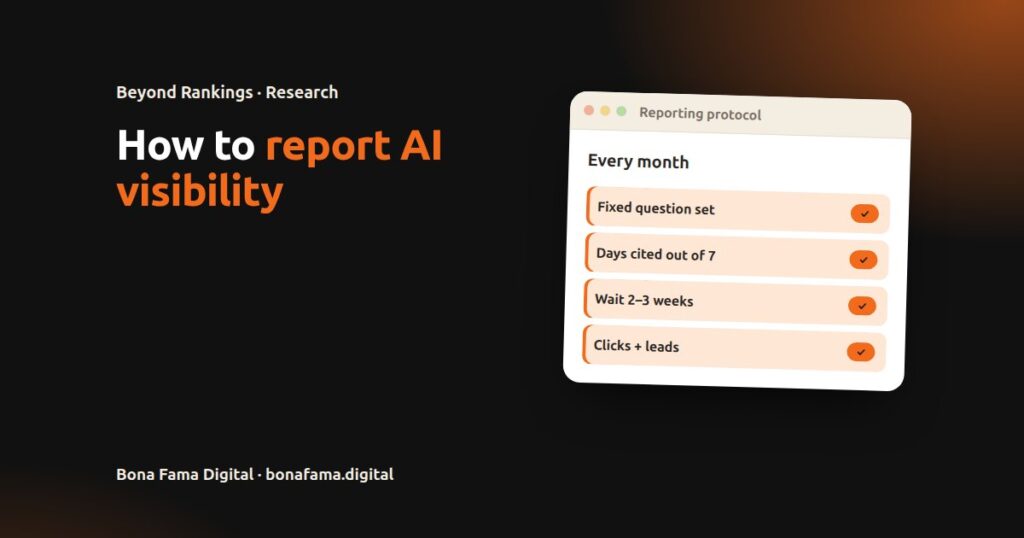
Because AI answers change from day to day, any AI-visibility report built on single checks will mostly measure noise. A reliable report tracks a fixed set of questions repeatedly, counts “days cited out of the last seven” instead of “cited today,” waits two to three weeks before reacting to a loss, records citations, brand mentions and empty answers separately, and pairs every visibility metric with clicks and conversions.
This protocol comes from the eighth finding of Beyond Rankings, our review of 36 studies on search and AI visibility. It’s written for business owners reading AI reports, and for agencies writing them.
Why Do AI Visibility Reports Need a Protocol?
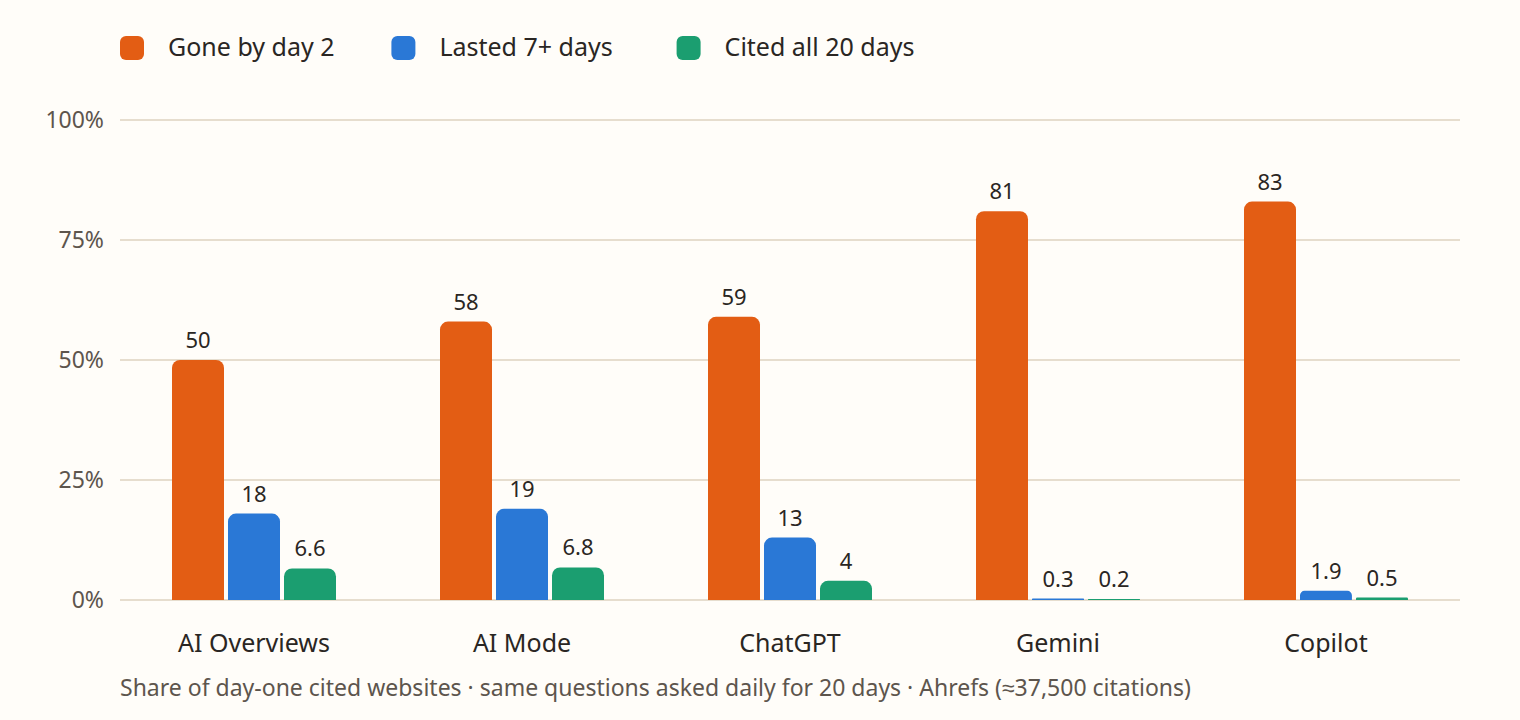
Because the underlying measure is unstable. Ahrefs asked five AI tools the same questions every day for 20 days and tracked about 37,500 citations. Half or more of the websites cited on day one were gone by day two. About three-quarters of the dropped citations came back within the 20 days.
Two more facts set the rules:
- New citations are fragile. About 70% were gone the next day.
- Citations that survive a week are durable. Of those that lasted 8 to 14 days before first dropping, no more than 4% failed to return, against 34% to 41% of those that lasted a single day.
Visibility Is Not the Same as Value
AI visibility tools measure the middle of the journey: whether a page is retrieved, cited or mentioned. Businesses are paid at the end: clicks and conversions.
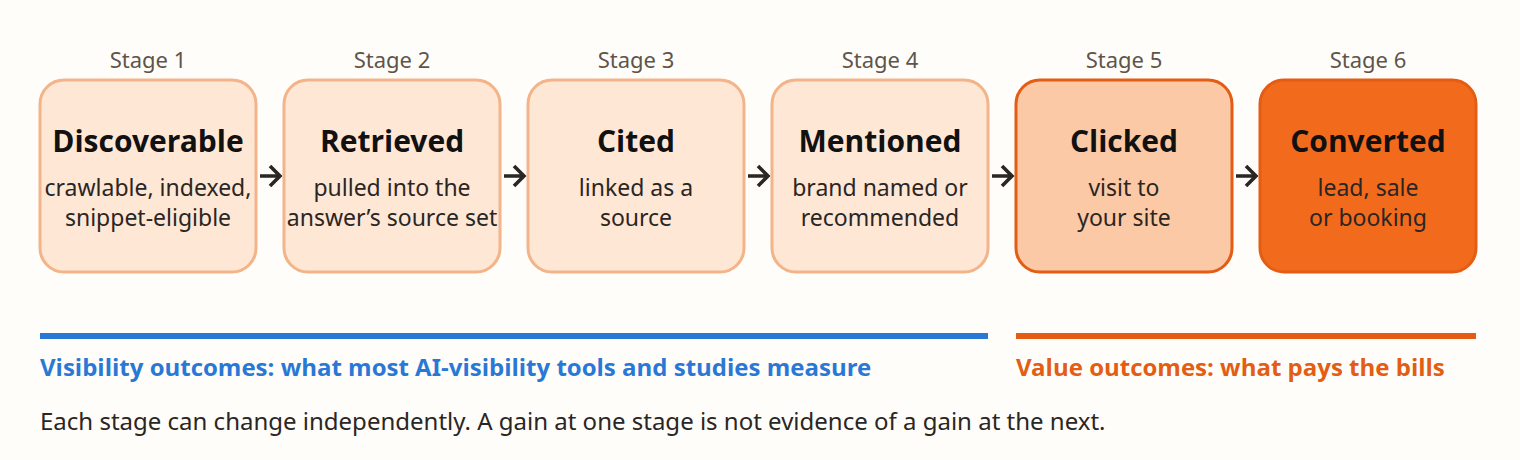
A report that stops at “you were cited 14 times” is reporting activity, not results.
The 8-Rule AI Visibility Reporting Protocol
| Rule | Why |
|---|---|
| 1. Track a fixed set of questions every day, or at least several times a week | One check can’t separate a real change from churn |
| 2. Report “days cited out of the last 7,” not “cited today” | Turns volatile yes/no results into a stable measure |
| 3. Wait two to three weeks before acting on a lost citation | About three-quarters of dropped citations return within 20 days |
| 4. Count a new citation only after it persists for several days | About 70% of new citations vanish the next day |
| 5. Record citations, brand mentions and empty answers separately | They move independently; empty answers inflate apparent losses |
| 6. Report by platform | Gemini and Copilot churn far more than Google’s AI features and ChatGPT |
| 7. Pair visibility metrics with clicks and conversions | Visibility is stages 2–4; value is stages 5–6 |
| 8. Never credit an SEO change for a gain that falls inside normal churn | Citations come and go without any intervention |
This applies the published evidence; the precise thresholds would need longer datasets to confirm.
What a Good Monthly AI Visibility Report Looks Like
- The question set: the same 20–50 customer questions every month, grouped by topic and type (factual, comparison, “best”).
- Visibility, per platform: for each question, days cited out of the last 7, days your brand was mentioned, and how often the answer cited no one.
- Search Console alongside it: clicks and click-through rate for the matching queries, split by whether an AI Overview appears.
- AI referrals: visits, leads and sales from ChatGPT, Gemini, Perplexity, Copilot and Claude, tracked as their own analytics channel.
- Changes made, and when: so any later movement can be checked against normal churn before anyone takes credit.
Questions to Ask Your Agency or Tool Vendor
- How often do you check each question, and do you report a rolling count or a single snapshot?
- Do you record citations, mentions and empty answers separately?
- Are AI Overview labels recorded at the time, or applied later?
- How do you connect visibility to clicks, leads and sales?
If the answers are vague, the report is probably measuring noise.
Build Your AI Visibility Report on Real Questions
FamaCue gives you the two halves of this protocol in one place. It asks ChatGPT, Claude, Gemini and Perplexity your customers’ real questions automatically, checks Google’s AI Overview, and shows which sites each one cites. Its before-and-after tracking then measures what changed in impressions, clicks and position after you publish. Agencies can run it for client websites on the Agency plan. Try it free for 7 days, no card needed.
Start reporting AI visibility with FamaCue
Frequently Asked Questions
How do you measure AI visibility?
Track a fixed set of customer questions across each AI platform several times a week, and report how many of the last seven days you were cited or mentioned.
How often should AI visibility be checked?
Daily if possible, or at least several times a week. A single check can’t tell a real change from normal day-to-day churn.
Should AI visibility reports include clicks and conversions?
Yes. Citations and mentions are visibility; clicks, leads and sales are value. Report both.
Why did my AI visibility report change so much from last month?
Possibly normal churn. Half or more of AI citations change from one day to the next, and most dropped citations return within 20 days.
Sources
- Kimachia, K. (2026). Beyond Rankings. Bona Fama Digital. Finding 8.
- Makosiewicz, M., & Guan, X. (2026). How stable are AI citations? 10 things we learned tracking 37,500 citations. Ahrefs.
- McDonald, T., Cooley, H., & Williams, M. (2026). AIO impact on Google CTR: 2026 update. Seer Interactive.