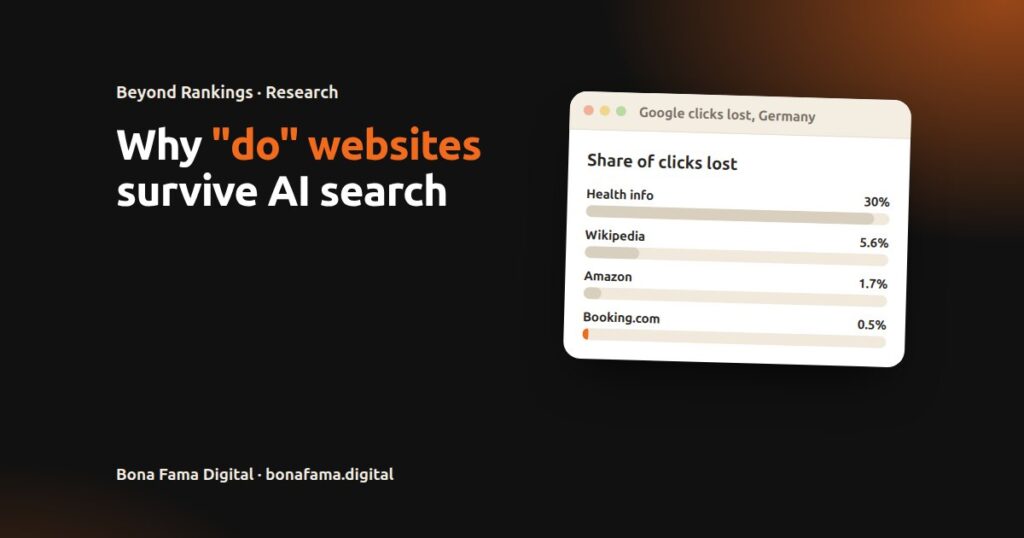
AI answers replace some website visits far more than others. Pages that exist to give a short answer are the most exposed. Pages where people book, buy, calculate or check live information are the least exposed. In Germany, health-information sites lost around 30% of their Google clicks to AI Overviews, while booking and weather sites lost under 0.5%. And sites that gained after Google’s December 2025 update were far more likely to let visitors complete a task or offer a product.
This is the sixth finding of Beyond Rankings, our review of 36 studies on search and AI visibility. For most small businesses, it’s good news.
Which Websites Lose the Most Clicks to AI Overviews?
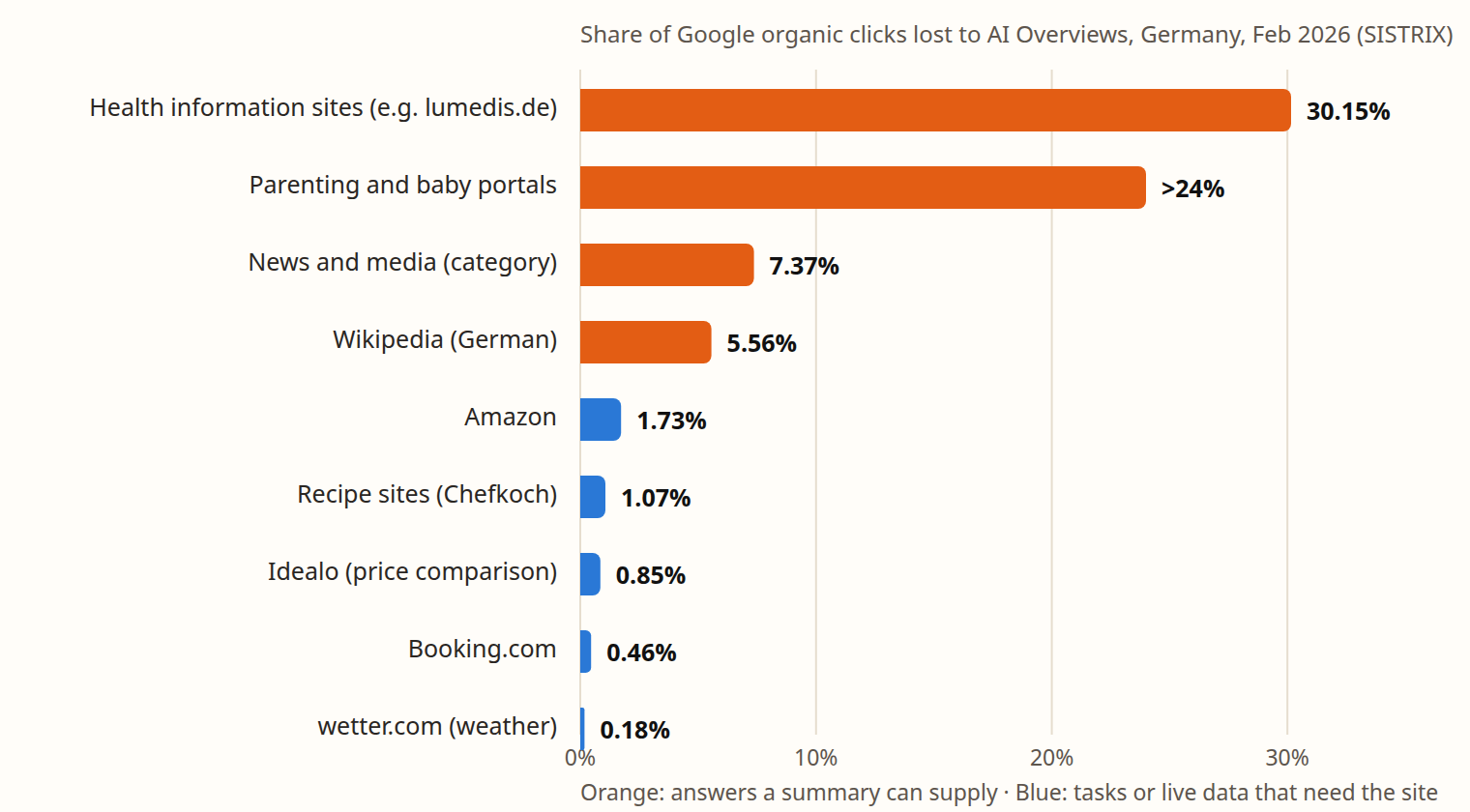
SISTRIX measured how much of each site’s or category’s Google clicks AI Overviews took in Germany in February 2026.
| Site or category | Share of Google clicks lost |
|---|---|
| Health-information sites | Around 30% |
| Parenting and baby portals | Over 24% |
| Wikipedia | 5.56% |
| Amazon | 1.73% |
| Recipe site Chefkoch | 1.07% |
| Price-comparison site Idealo | 0.85% |
| Booking.com | 0.46% |
| Weather site wetter.com | 0.18% |
The same pattern shows up elsewhere. In France, health was the most exposed sector. In the US randomized experiment, the click loss was concentrated on informational queries; for navigational and transactional searches, the effect couldn’t be distinguished from zero. And a peer-reviewed study found AI Overviews on 64.7% of question-form queries, against 9.5% of others.
What Do Winning Websites Have in Common?
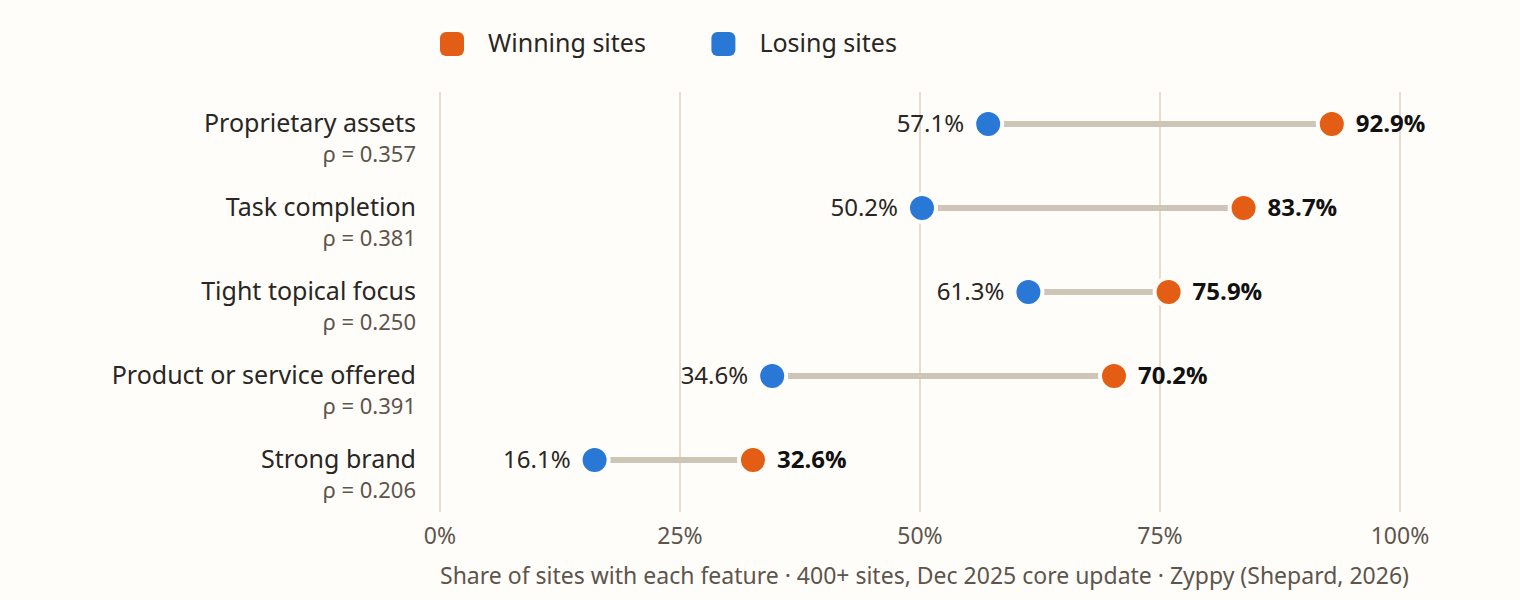
Zyppy classified more than 400 websites that won or lost Google traffic around the December 2025 core update.
| Feature | Winners | Losers |
|---|---|---|
| Proprietary assets (databases, tools, original reviews) | 92.9% | 57.1% |
| Lets users complete a task | 83.7% | 50.2% |
| Offers a product or service | 70.2% | 34.6% |
Sites with four or five of these features won 68% to 70% of the time, against 13.5% for sites with none.
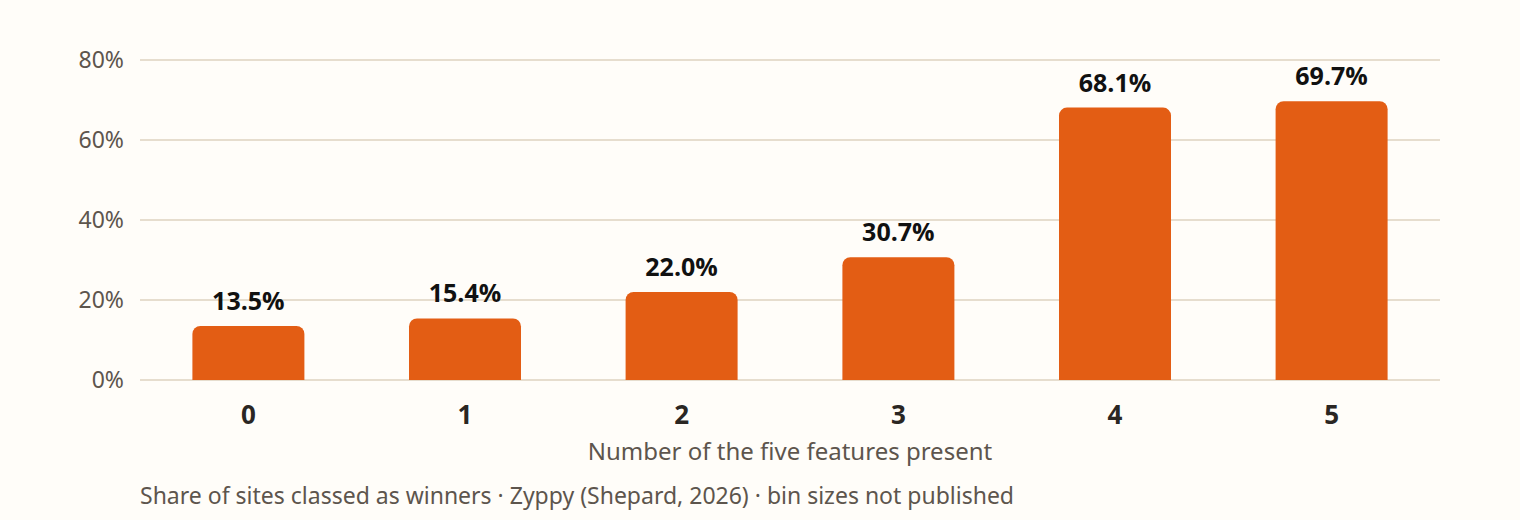
A caution: the correlations are modest, the sites were selected rather than sampled, and the features were coded by hand. On its own the study is suggestive. Together with the SISTRIX categories and the experiment’s results by search intent, it supports a consistent explanation.
A Simple Test: Can a Summary Replace This Page?
We classify pages with two questions: can a short answer satisfy the need, and does the visitor need to act on a site?
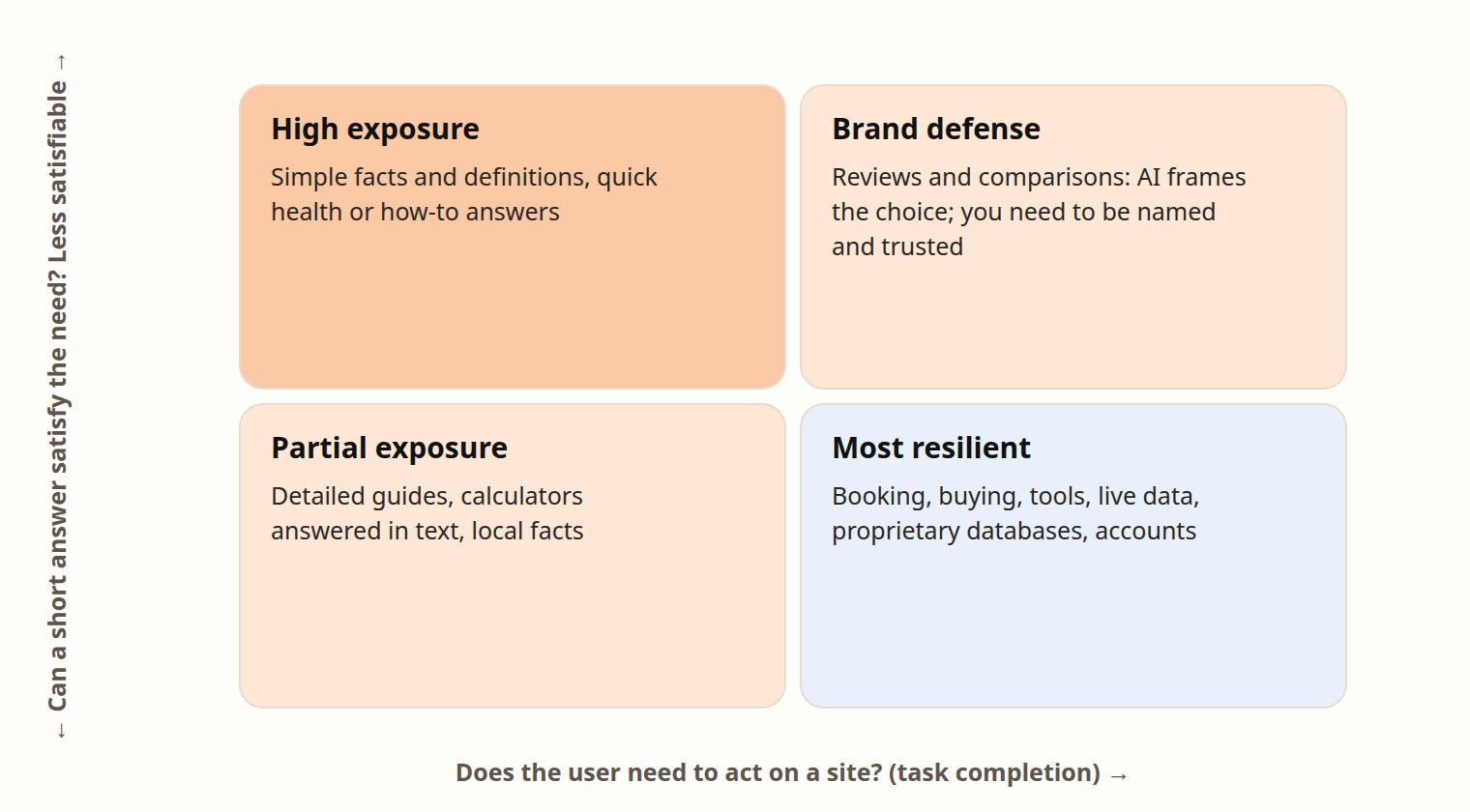
- High exposure: a summary answers the question and nothing needs doing on a site, such as definitions and simple how-to facts.
- Most resilient: the visitor needs to act, such as booking, getting a quote, buying, checking availability or using a calculator.
Why This Is Good News for Small Businesses
A plumber, dentist, accountant, retailer or tour operator exists to complete a task: a booking, a quote, a purchase, an appointment. Their core pages usually sit in the “most resilient” quadrant. Only the informational blog content they publish to attract visitors is highly exposed. (Whether adding a tool or booking feature causes resilience hasn’t been tested yet.)
What to do:
- Put effort where visitors act: service pages, booking, quotes, product pages, calculators, availability and pricing. Good landing pages and funnels matter more than ever.
- Keep informational content, but judge it differently. Expect fewer clicks; measure whether it builds recognition and leads.
- Build assets competitors can’t copy: your own data, tools, original photos and genuine reviews.
Find the Questions That Lead to Action
Not every customer question is equal. FamaCue labels each real question from your Search Console data and from Google by intent, so you can separate “learning” questions that AI answers well from commercial questions that lead to a booking or purchase. Its content plan then tells you whether to create, improve or update a page for each topic. Try it free for 7 days.
See your commercial questions in FamaCue
Frequently Asked Questions
Which websites are most affected by AI Overviews?
Sites that mainly give short answers. In Germany, health-information sites lost around 30% of Google clicks, against under 0.5% for booking and weather sites.
Are small business websites safe from AI search?
Their core pages usually are, because visitors come to book, buy or get a quote. Informational blog content is more exposed.
What makes a website resilient to AI search?
In a study of 400+ sites, winners were far more likely to let users complete a task, offer a product or service, and have proprietary assets such as tools, data or original reviews.
Should I stop publishing blog content?
No, but judge it by recognition and leads rather than traffic alone, and invest more in pages where visitors act.
Sources
- Kimachia, K. (2026). Beyond Rankings. Bona Fama Digital. Finding 6.
- Beus, J. (2026). AI overviews in Germany: How much click-through rates are really dropping. SISTRIX.
- Shepard, C. (2026). 5 data-backed features of websites winning Google in 2026. Zyppy Signal.
- Begue, J., & Guan, X. (2026). AI overviews cut CTR by 23.1% in France. Ahrefs.
- Rijo, L. (2026). AI Overviews cut publisher clicks 39.8% in first randomized study. PPC Land.
- Xu, H., Iqbal, U., & Montgomery, J. M. (2026). Measuring Google AI overviews. ACM Internet Measurement Conference.