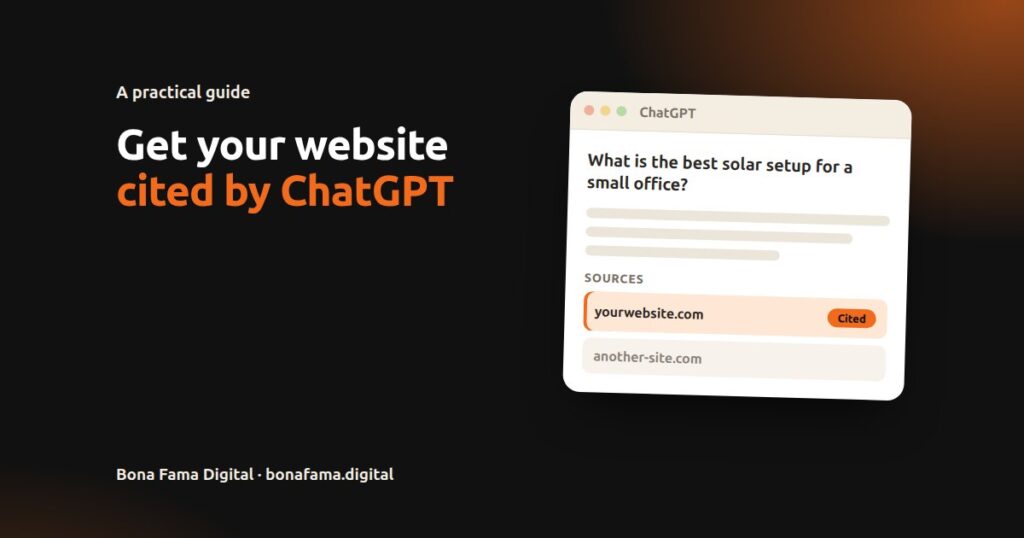
To get your website cited by ChatGPT, make it reachable and worth citing. First, allow OpenAI’s search crawler, OAI-SearchBot, in your robots.txt file and firewall so ChatGPT can find your pages. Then publish original, question-focused content that answers buyers’ questions directly and backs its claims with evidence. Build credible mentions on other reputable websites, then track citations and ChatGPT referral traffic each month. No method guarantees a citation, but these steps make one much more likely.
The discipline behind this is often called Generative Engine Optimization (GEO) or Answer Engine Optimization (AEO). Traditional SEO tries to rank a page in a list of links. GEO tries to make your website a source that AI assistants discover, trust, and reference when they answer a question.
For example, when a prospect asks ChatGPT, “What’s the best solar setup for a small office in Sydney?”, the goal is for the answer to cite a helpful page on your website, ideally with a clickable link.
Does ChatGPT Guarantee Which Websites It Cites?
No. OpenAI doesn’t sell placement in ChatGPT’s answers and doesn’t publish a ranking formula. Its Publishers and Developers FAQ explains how to make your content eligible for discovery and citation, but which sources appear for a given question depends on many relevance and reliability factors.
That changes the goal. You can’t “rank #1 in ChatGPT.” You can make your site the most accessible, credible, and useful source on the topics you know best. That’s the job of the steps below.
How Do I Make Sure ChatGPT Can Crawl My Website?
This step is essential. If ChatGPT can’t reach your content, nothing else matters.
OpenAI’s crawler documentation says that OAI-SearchBot is used to surface websites in ChatGPT’s search features. It also says that sites which block it won’t be shown in ChatGPT search answers, though they can still appear as plain navigational links.
Add this to your robots.txt file:
User-agent: OAI-SearchBot
Allow: /
Then check these common blockers:
- Firewalls and CDNs: Cloudflare and other security tools sometimes block AI crawlers by default. Allow OpenAI’s published OAI-SearchBot IP addresses.
- Accidental
noindextags: these are common on staging sites that were pushed live. - Status codes: important pages should return an HTTP 200 response.
- Logins and paywalls: content behind a login can’t be read or cited.
- JavaScript-only content: key information should be in readable HTML.
OpenAI notes that robots.txt changes can take about 24 hours to affect search results, so recheck a day after you update the file.
Related: technical SEO audit
What’s the difference between OAI-SearchBot and GPTBot?
OpenAI runs separate crawlers for separate purposes, and each one is controlled independently:
| User agent | What it does | What blocking it does |
|---|---|---|
| OAI-SearchBot | Finds and indexes pages for ChatGPT search | Removes your pages from ChatGPT search answers |
| GPTBot | Collects content that may be used to train OpenAI’s models | Signals that your content shouldn’t be used for training |
| ChatGPT-User | Visits a page when a user’s request needs it | Isn’t an automatic crawler, and robots.txt may not apply |
This means you can allow search crawling while opting out of model training. Plenty of businesses do exactly that.
What Kind of Content Does ChatGPT Cite?
ChatGPT users usually type complete questions rather than short keywords. Pages that answer those questions directly are easier to match and quote.
| Traditional keyword | Question a buyer asks ChatGPT |
|---|---|
| Accounting software Sydney | Which accounting software is best for a small business in Sydney? |
| Shopify SEO | How do I get my Shopify products to show up in AI search? |
| Office solar installation | How much does a solar system for a small office cost? |
| Google Ads agency | Should a small business run Google Ads or invest in SEO first? |
A service page can still target its commercial keyword while also answering the questions around it. For each important page:
- Open with a direct answer. Put a clear 40–80 word explanation near the top. This length is a practical editorial guideline, not a confirmed ChatGPT ranking factor.
- Expand with depth. Follow with explanations, examples, and comparisons.
- Use question-based headings. Make H2s and H3s match related questions people ask.
- Back up your claims. Link to primary sources, standards, or your own data.
This matches Google’s own advice. Google’s guidance on AI features in Search says the same fundamentals apply to AI Overviews and AI Mode: crawlable pages, internal links, a good page experience, and important content available as text. Google doesn’t require special AI markup.
Related: AI SEO Sydney
Why Isn’t My Content Being Cited, Even When It Ranks?
Many commercial websites fall short here. Their pages describe the business instead of informing the reader.
Compare these two passages:
Generic: “We provide high-quality digital marketing solutions for businesses across Sydney.”
This says who you are but gives an AI assistant nothing to quote.
Citation-worthy: “Local SEO, Google Ads, and AI search optimization solve different problems. Local SEO builds long-term visibility in map results, Google Ads buys immediate placement for high-intent searches, and AI search optimization makes your content citable in tools like ChatGPT. The right mix depends on your budget, sales cycle, and how quickly you need leads.”
The second passage explains a decision. It’s useful, specific, and easy to quote.
To become a source rather than one more site repeating what’s already online, add:
- Original data, such as your own pricing ranges, survey results, or performance benchmarks
- First-hand testing and real-world experience
- Technical specifications and detailed comparison tables
- Documented case studies, with numbers your client has approved for publication
- Expert commentary from named people
- References to the relevant standards or regulations
Google’s May 2026 guide to generative AI features makes the same point. It stresses valuable, unique, non-commodity content. If your page says what a hundred other pages already say, an AI system has little reason to cite it.
Related: case studies
Do Backlinks and Third-Party Mentions Help With ChatGPT Citations?
They help build authority, but treat them carefully.
ChatGPT can learn about your business from many sources besides your own website. Consistent, credible evidence of your expertise across independent sites strengthens the overall picture. Good opportunities include:
- Industry associations and professional directories
- Guest articles in established trade publications
- Interviews and expert commentary
- Local and industry news coverage
- Genuine reviews on independent platforms, such as Google reviews
- Research or resources that other sites choose to reference
An important caveat: OpenAI hasn’t said that third-party metrics such as Domain Authority affect ChatGPT citations. A link from a high-authority site isn’t automatically a strong GEO signal. Prioritize editorial relevance and reputation over link volume, and avoid paid link schemes, which carry real risk with Google.
Related: backlink strategy
Does Schema Markup Help Get My Site Cited by ChatGPT?
Structured data helps search engines understand what a page is about and who’s behind it. Google documents this in its introduction to structured data. Useful types for most business websites include:
| Schema type | Best use |
|---|---|
Organization |
Company identity and official details |
LocalBusiness |
Businesses serving specific locations |
Service |
Individual service offerings |
Product |
Products and specifications |
Article |
Educational content and insights |
Person |
Author and expert profiles |
BreadcrumbList |
Site structure |
FAQPage |
Genuine question-and-answer content |
Use JSON-LD, and make sure the markup matches what visitors can see on the page. There’s no confirmed ChatGPT citation boost from schema, so treat it as part of good technical SEO, not a GEO shortcut.
How Do I Help ChatGPT Understand Who My Business Is?
AI systems think in entities: recognizable people, companies, products, and places. You want ChatGPT to connect your brand with your real expertise, services, and locations. To build those connections:
- Keep a detailed About Us page.
- Name the people who write or review technical content, and publish author bios with their qualifications.
- State your service areas and office locations clearly.
- Keep your business name, address, and contact details consistent across every profile.
- Publish substantial case studies that show real work.
- Link to authoritative sources that support your claims.
These are good-practice recommendations based on information quality. They aren’t a disclosed ChatGPT ranking formula.
How Should I Structure a Page So ChatGPT Can Extract Answers?
Make the relevant information easy to find and quote. A service page might follow this pattern:
- H1: Website Design Sydney
- Intro: what the service is and who it’s for
- H2: What does a professional website design include? (a direct, self-contained answer)
- H2: Types of business websites (comparisons and use cases)
- H2: How much does a business website cost in Sydney? (honest pricing factors and ranges)
- H2: How do I choose the right web designer? (practical selection criteria)
Also:
- Keep each explanation together instead of scattering it across the page.
- Use tables for real comparisons.
- Show accurate publication and “last updated” dates.
- Keep sales language out of the educational sections.
- Make sure the full content works on mobile.
Related: on-page SEO
How Do I Know If ChatGPT Is Citing My Website?
Track two separate things: citation visibility, meaning whether ChatGPT names or links your site, and referral traffic, meaning whether people click through.
Referral traffic is the easier one. OpenAI confirms that ChatGPT automatically adds utm_source=chatgpt.com to its referral links. In Google Analytics 4, filter by that source to see visits and conversions.
Citation visibility takes a repeatable test. Write 10–20 prompts that match real customer questions, run them in ChatGPT with search turned on, and record:
| Metric | What to record |
|---|---|
| Citation frequency | How often your domain is cited |
| Cited URLs | Which of your pages appear |
| Competitor citations | Which other domains are cited instead |
| Brand mentions | How often your business is named |
| Referral traffic | Visits from chatgpt.com |
| Conversions | Inquiries or sales from those visits |
Rerun the same prompts monthly. AI answers vary between sessions, so judge the trend over time rather than any single result.
Related: web analytics setup
What Should I Do First?
For an established business website, we recommend this order:
| Priority | Action | Importance |
|---|---|---|
| 1 | Allow OAI-SearchBot and fix crawler blocks | Essential |
| 2 | Publish helpful, question-focused content | Very high |
| 3 | Add original data, expertise, and comparisons | Very high |
| 4 | Earn relevant third-party mentions | High |
| 5 | Strengthen entity and author information | High |
| 6 | Fix indexing, canonical, and technical SEO issues | High |
| 7 | Add appropriate schema markup | Supporting |
| 8 | Track citations and ChatGPT referrals | Essential for measurement |
This is our recommended working order, not an official weighting of ChatGPT’s ranking factors.
Frequently Asked Questions
How long does it take to get cited by ChatGPT?
Crawler changes can take effect in about 24 hours, according to OpenAI. Earning citations takes longer, because it depends on publishing strong content and building authority. Most businesses should judge progress over several months of monthly tracking.
Will blocking GPTBot stop ChatGPT from citing my website?
No. GPTBot relates to model training. ChatGPT search relies on OAI-SearchBot. You can block GPTBot and still allow OAI-SearchBot.
Can I pay to be cited by ChatGPT?
No. OpenAI doesn’t sell placement in ChatGPT’s search answers. Citations come from being accessible, relevant, and credible.
Is getting cited by ChatGPT different from ranking on Google?
They overlap heavily. Crawlability, helpful content, and authority matter for both. The difference is that AI answers favor content that responds to specific questions directly and can be quoted cleanly.
Find the Questions Your Website Should Be Answering
Getting cited by ChatGPT starts with knowing which questions your customers ask, and which ones your website doesn’t answer yet. FamaCue, built by Bona Fama Digital, finds the real questions people search, shows which sites AI assistants cite for them, and turns the gaps into a content plan with ready-to-edit drafts.
👉 Start your free 7-day FamaCue trial. No card required.
Want experts to handle it for you? Our AI Search Optimization packages include a FamaCue plan at no extra cost.