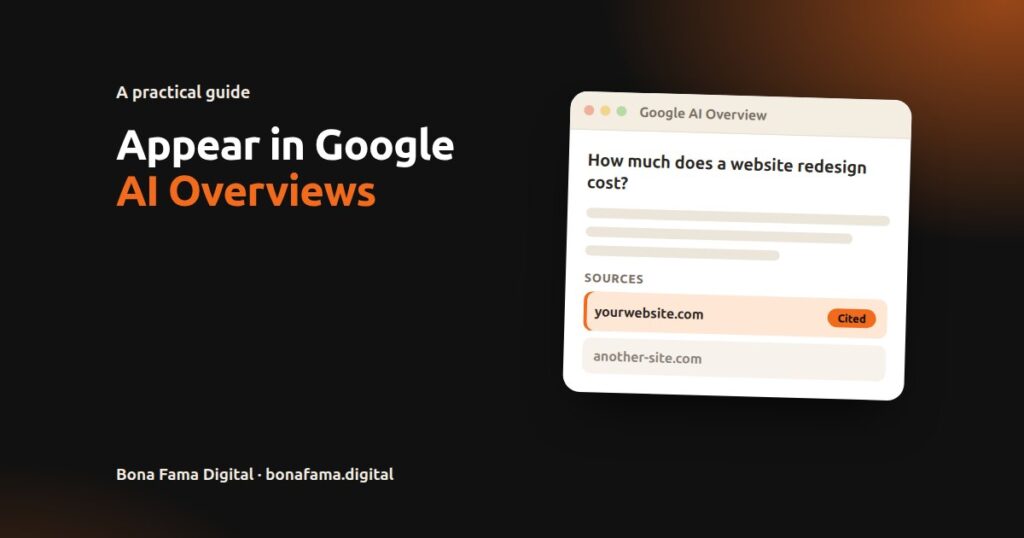
To appear in Google AI Overviews, your page must first be indexed by Google and eligible to show a snippet in normal search results. Google doesn’t require any special AI markup or files. After that, being cited depends on quality: answer customers’ questions directly, publish original information competitors don’t have, cover your topic in depth, and show real expertise. Track your progress in Search Console’s generative AI performance report.
Google has published official guidance on this, and its core message is simple: optimizing for AI Overviews is still SEO. Google’s guide to optimizing for generative AI features, published in May 2026, says these features are rooted in the same ranking and quality systems as regular Search. There’s no separate AI ranking layer to game.
Being eligible and being cited are different things, though. The rest of this guide covers how to close that gap.
How Does Google Choose Sources for AI Overviews?
AI Overviews build their answers from pages in Google’s search index. When someone searches, for example, “Is Colorbond or tile roofing better for a home in Brisbane?”, Google might generate a short comparison of durability, heat performance, and cost, with links to the pages that support it. Your goal is to be one of those supporting links.
Google also uses a technique called query fan-out. According to Google’s AI features documentation, AI Overviews and AI Mode may run several related searches across subtopics while building a response. That means a page can be cited because it answers one part of a complex question, even if it doesn’t match the searcher’s exact wording.
In practice, a well-structured page about “roof heat performance in subtropical climates” could earn a citation in an answer about Brisbane roofing choices.
Related: AI SEO Brisbane
What Are the Technical Requirements for AI Overviews?
Google’s requirements are the standard Search requirements:
- The page is indexed. Check with the URL Inspection tool in Google Search Console.
- The page is eligible for a snippet. Directives such as
nosnippet,data-nosnippet, or a very shortmax-snippetlimit what Google can show, including in AI features. - Googlebot can crawl it. Check robots.txt, your CDN, and any firewall rules.
- Important content is in text. Key information shouldn’t be locked in images or scripts that don’t render.
Google states there are no additional technical requirements for AI features. Its optimization guide also lists things you don’t need to do, including special schema.org markup, llms.txt or other AI text files, and AI-specific rewrites of your content.
One more check: in 2026, Google added a generative AI control in Search Console that lets site owners opt out of AI Overviews and AI Mode. If your site isn’t appearing, confirm nobody switched it off.
Note: Meeting the technical requirements makes you eligible. It doesn’t guarantee that Google will crawl, index, or cite a page.
Related: SEO audit
What Kind of Content Gets Cited in AI Overviews?
Answer questions directly
Many commercial service pages only sell. AI Overviews need pages that inform.
Sales-only copy: “Brisbane Roof Co. offers high-quality roofing solutions across Brisbane.”
This tells Google who you are, but gives it nothing to use in an answer.
Answer-oriented copy: “Colorbond steel roofing is lighter and reflects more heat when chosen in a light color, which suits Brisbane’s hot, humid summers. Concrete and terracotta tiles are heavier and more expensive to install, but they’re quieter in heavy rain and can last decades with regular maintenance.”
The second version answers a real question. For each important page:
- Identify five to ten questions customers actually ask.
- Answer the main question early, in 40–80 words.
- Use descriptive H2 headings that match those questions.
- Follow short answers with detailed explanations.
- Add specifications, examples, and comparisons where they help.
Related: on-page SEO
Publish information competitors don’t have
Google’s guide stresses valuable, unique, non-commodity content. Google says creating unique, engaging, and helpful content will do more for your AI search presence over time than any other suggestion in the guide.
If your page repeats what dozens of competitor pages already say, Google has little reason to cite yours. Original material that stands out includes:
- Real project case studies with outcomes your client has approved for publication
- Original photographs of your work
- Product test results and first-hand comparisons
- Transparent pricing information or realistic price ranges
- Expert opinions grounded in experience
- Original survey findings
- Local market insight, such as how Queensland conditions affect product choice
This matters most in industries where most businesses publish nearly identical service descriptions.
Related: competitor SEO benchmarking · case studies
How Do I Build Topical Authority for AI Overviews?
Don’t build isolated SEO pages. Build a connected set of resources that covers your subject thoroughly. A Brisbane roofing company might have:
| Page type | Example |
|---|---|
| Main service page | Roof Replacement Brisbane |
| Comparison | Colorbond vs Tile Roofing: Which Suits Brisbane? |
| Cost guide | How Much Does a Roof Replacement Cost in Brisbane? |
| Standards explainer | Cyclone and Wind Ratings for Queensland Roofs |
| Buyer’s guide | How to Choose a Roofing Contractor |
Each supporting article links to the main service page and to related guides. Because of query fan-out, this gives Google several relevant pages to retrieve when it answers different parts of a complex question.
Related: content marketing services
How Do I Show Google That My Content Is Credible?
Make it easy for visitors and Google to see who is responsible for the information. Google’s guidance on creating helpful, reliable, people-first content asks whether content shows first-hand experience and expertise. Include:
- Author names and relevant professional experience
- Clear business details, including address, licensing, and contact information
- References to authoritative primary sources
- Genuine customer reviews and documented projects
- Relevant qualifications and industry memberships
- Accurate publication and “last updated” dates
These strengthen content quality. None of them guarantees an AI Overview citation on its own.
Does Structured Data Help You Appear in AI Overviews?
Not directly. Google’s optimization guide says structured data isn’t required for generative AI search and there’s no special AI schema to add. Still, structured data remains useful for rich results and for helping Google understand your pages. For service businesses, the most useful types are usually:
OrganizationandLocalBusinessServiceandProductArticleBreadcrumbList
Keep the markup accurate and matched to the visible content. Treat it as good SEO hygiene, not an AI Overview shortcut.
How Can I Tell If My Website Appears in AI Overviews?
Google now reports this directly. On June 3, 2026, Google introduced Search generative AI performance reports in Search Console. They started with a limited test group, and Google completed the worldwide rollout on August 31, 2026.
The report shows:
- How often your pages appear in Google’s generative AI features
- Which URLs earn those impressions
- Countries and devices
- Trends over time
Where to find it:
- Open Google Search Console and select your property.
- Go to the Performance report.
- Expand the generative AI tab.
- Note which pages already appear.
- Compare them with your most valuable commercial pages and keywords.
Limitations: the report shows that a page appeared, not why Google chose it. AI Overviews and AI Mode are reported together. Google also counts AI feature impressions in your regular Performance data under the “Web” search type, so don’t add the two figures together.
Related: web analytics setup
How Do I Find AI Overview Opportunities Competitors Are Winning?
This is one of the most useful exercises you can run. Suppose you run a roofing business in Brisbane. Search Google for questions like:
- How long does a Colorbond roof last in Queensland?
- What’s the difference between a roof restoration and a roof replacement?
- How much does it cost to re-roof a house in Brisbane?
- Do I need council approval to replace my roof in Queensland?
- What roof color keeps a house coolest?
For every query that triggers an AI Overview, record the websites and URLs Google cites, then evaluate:
| Question | What to investigate |
|---|---|
| Who is cited? | Government sources, manufacturers, competitors, or publishers? |
| What kind of page? | Service page, guide, comparison, or technical article? |
| Why is it useful? | Original data, clear explanations, or authoritative evidence? |
| What’s missing? | Can you add better examples or more specific local detail? |
| Can you compete? | Do you have the expertise and evidence to build a better resource? |
The aim is to find topics where your business can add information that current sources don’t cover well.
Related: keyword research
What Tactics Should I Avoid?
Several popular “AI SEO” tactics don’t hold up:
- Mass-producing AI-written articles. Volume without originality is exactly the commodity content Google’s guide warns against.
- Adding dozens of FAQs to every page. A few genuinely useful questions beat repetitive filler.
- Buying links based on third-party authority scores. Those scores aren’t Google ranking signals, and paid links violate Google’s spam policies.
- Adding
llms.txtjust for AI Overviews. Google says it doesn’t need it. - Assuming schema guarantees citations. It doesn’t.
- Stuffing question keywords into every heading. Content still has to read naturally.
Related: backlink strategy
A 30-Day Plan to Improve AI Overview Visibility
| Week | Focus | Actions |
|---|---|---|
| 1 | Technical audit | Check indexing, snippet eligibility, crawlability, canonical tags, current rankings, and the Search Console generative AI report |
| 2 | Competitor research | Test 20–30 customer questions, record which trigger AI Overviews, and document the cited domains |
| 3 | Content improvement | Upgrade five high-value pages with direct answers, original expertise, comparisons, and evidence |
| 4 | Authority and measurement | Publish two or three substantial supporting guides, strengthen internal links, and set an AI visibility baseline |
These are working milestones, not a promise of citations within 30 days.
Google AI Overviews vs ChatGPT: What’s Different?
| Factor | Google AI Overviews | ChatGPT Search |
|---|---|---|
| Discovery system | Google’s search index | OpenAI’s search crawler and search partners |
| Crawler to allow | Googlebot | OAI-SearchBot |
| Google indexing required | Yes | No |
| Traditional SEO | Directly relevant | Helpful |
| Special AI schema required | No | No confirmed requirement |
| Guaranteed method | None | None |
| How to measure | Search Console generative AI report | Citation testing and utm_source=chatgpt.com referrals |
Most of the work overlaps: original expert content, sound technical SEO, clear answers, credible business information, and topical depth. Optimize for both together.
Related: How can I get my website cited by ChatGPT?
Frequently Asked Questions
Do I need special schema to appear in Google AI Overviews?
No. Google says structured data isn’t required for its generative AI features and there’s no special AI schema. Standard structured data still helps with rich results and with how Google understands your pages.
Can I pay to appear in Google AI Overviews?
No. Organic citations in AI Overviews can’t be bought. They come from being indexed, eligible for snippets, and genuinely useful.
Does ranking on page one guarantee an AI Overview citation?
No. Strong rankings help, because AI Overviews draw on Google’s core ranking systems. But Google may also cite pages that answer one part of a broader question through query fan-out.
How long does it take to appear in AI Overviews?
There’s no fixed timeline. Technical fixes can take effect once Google recrawls your pages, which can take days to months. Citations from improved content usually build over several months.
Can I stop my content from appearing in AI Overviews?
Yes. You can limit snippets with nosnippet or max-snippet, keep pages out of the index with noindex, or use the generative AI control in Search Console. Each option can also reduce your visibility in regular search.
Find the Questions Google’s AI Is Answering in Your Industry
Winning AI Overview citations starts with knowing which questions your customers search, and who Google cites for them today. FamaCue, built by Bona Fama Digital, imports your real search questions from Google Search Console, shows which sites Google AI Overviews and AI assistants cite, and turns the gaps into a content plan with ready-to-edit drafts.
👉 Start your free 7-day FamaCue trial. No card required.
Prefer to have experts handle it? Our AI Search Optimization packages include a FamaCue plan at no extra cost.
Sources
- Google Search Central: Optimizing your website for generative AI features on Google Search
- Google Search Central: AI features and your website
- Google Search Central Blog: A new resource for optimizing for generative AI in Google Search
- Google Search Central Blog: Introducing Search generative AI performance reports in Search Console
- Google Search Central: Creating helpful, reliable, people-first content
- Google Search Central: Introduction to structured data
- OpenAI: Overview of OpenAI Crawlers